Dafabet Singapore: legal status and clone-domain checks
Start with the hostname, not the logo
A lookalike-domain check is the most useful first step for anyone searching for Dafabet Singapore legal information. The recorded exact domain in this review is dafabet.com. That spelling is only an identifier for the evidence packet; it is not a finding that every page using the name, a subdomain, a mirror, an advertisement or a mobile application is controlled by the same party.
Before opening a login or payment page, read the complete hostname from the address bar. Check every letter, the ending after the final dot, the presence of unexpected hyphens and whether a link has redirected through a tracking or shortened address. A padlock or HTTPS connection protects the connection to the host but does not establish a Singapore gambling licence. Nor does a matching colour scheme, favicon or brand image prove ownership.

| Check | What to compare | What it cannot prove |
|---|---|---|
| Hostname | Exact spelling of dafabet.com and the full address after any redirect | That the host is licensed in Singapore |
| Connection | HTTPS, certificate warnings and whether the address changes unexpectedly | That the page is operated by the named business |
| Brand presentation | Logo, colours, wording and page layout | Authenticity, lawful access or safe withdrawals |
| Account destination | Where login, identity documents and payment instructions are sent | That an intermediary is authorised to collect funds |
If a message asks you to move to a different domain, treat that change as material. Save the address and the message before closing the page. Do not assume that a similar-looking mirror is a harmless technical alternative.
What the Singapore record supports
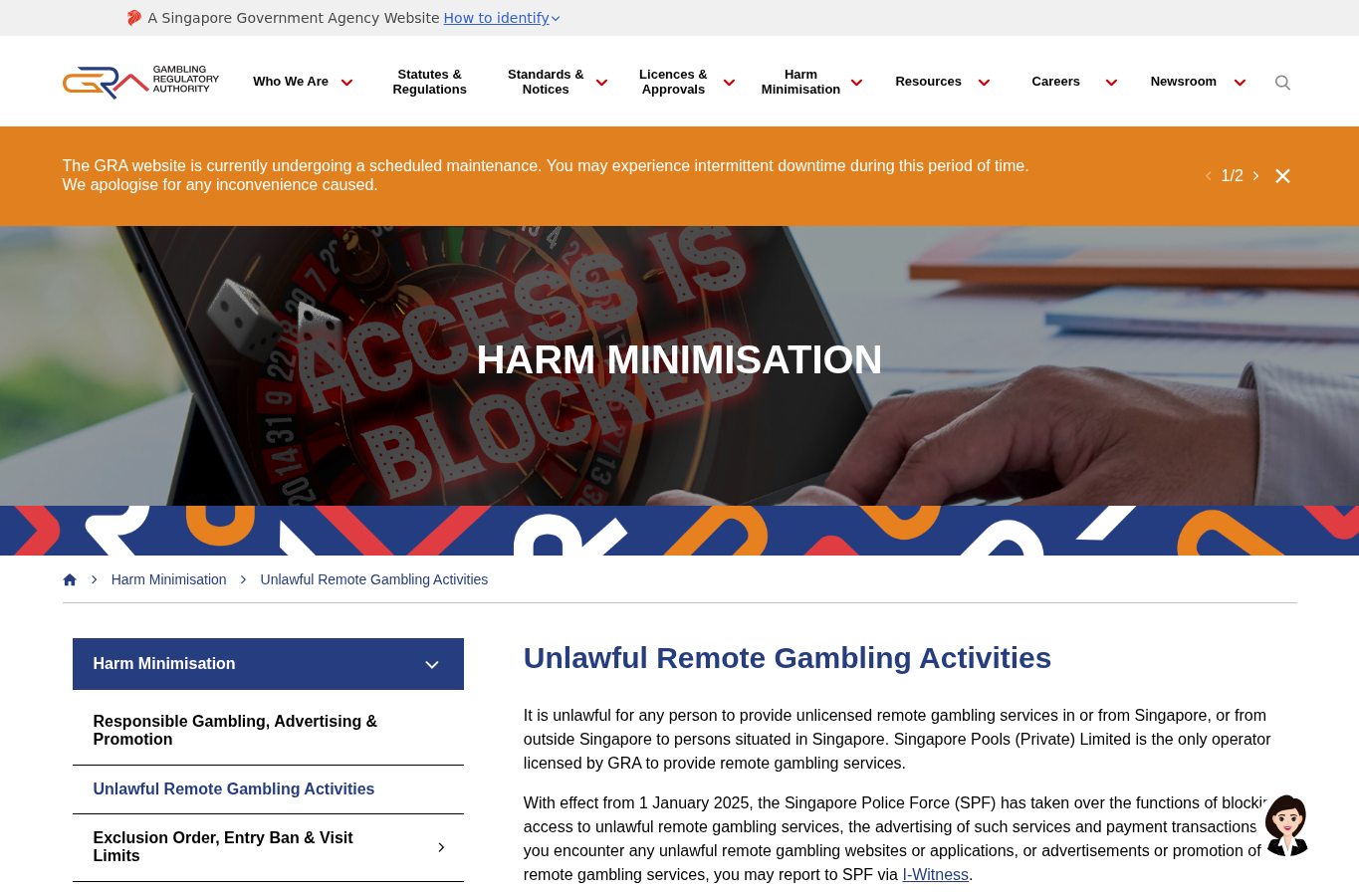
The supplied primary record from the Gambling Regulatory Authority states that Singapore Pools is the only operator licensed by GRA to provide remote gambling services. It also records that reporting moved to the Singapore Police Force from 1 January 2025. This is the strongest relevant evidence in the packet for the Singapore remote-gambling position.
The Ministry of Home Affairs explains that gambling in Singapore is prohibited unless it is licensed or exempted, and identifies GRA as the regulator of the sector. The Gambling Control Act provides the statutory definitions, offences and minimum-age framework. Those sources describe the legal framework; they do not establish that a particular unlicensed site is safe, nor do they decide the identity of a disputed mirror.
Read the official wording carefully. The fact that Singapore Pools is identified as the only GRA-licensed remote operator does not create a licence for another service. Conversely, the absence of a match in the supplied packet is an evidence gap rather than a judicial determination about every company or domain using the name. That distinction is why this dossier uses an amber signal.
| Question | Supported position | Boundary |
|---|---|---|
| Who is identified as Singapore’s licensed remote operator? | Singapore Pools, according to the supplied GRA record | This does not validate unrelated services |
| What is the general rule? | Gambling is prohibited unless licensed or exempted | The legal application may depend on facts not in this packet |
| Who regulates the sector? | GRA is identified by MHA as the regulator | Regulatory information is not a payment guarantee |
| What changed on 1 January 2025? | Reporting moved to SPF, according to the GRA record | It does not confirm that a private operator is authorised |
For the primary regulatory wording, consult the GRA remote-gambling information. The statutory framework is available in the Gambling Control Act, while the broader policy explanation appears in the MHA gambling-industry overview.
Host, operator and licence are separate questions
The evidence packet records the operator as Osmila N.V. (presented). The word “presented” matters: this is not a reconciled finding from a current Singapore register. The packet contains no current GRA match for Dafabet and no licence number or expiry date that can be adopted as a Singapore credential. A company name displayed on a website is therefore not enough to connect the legal entity, the exact host and the person receiving a payment.
Use three separate rows in your notes: the host you visited, the entity named in the terms or payment instructions, and the licence authority and number claimed for the relevant market. They should be checked against a current primary record before being treated as a match. A foreign licence claim, if encountered, would not by itself prove permission to offer remote gambling services in Singapore.
| Identity layer | Recorded information | Current assessment |
|---|---|---|
| Exact host | dafabet.com | Recorded domain; control of all related pages is not established |
| Operator | Osmila N.V. (presented) | Presented information requiring primary reconciliation |
| Singapore licence | No current GRA match found | Open evidence; no local licence adopted |
| Licence expiry | No date supplied | Unknown |
Do not fill an empty licence field with a guessed jurisdiction, number or expiry date. If the page shows a different legal entity from the one recorded here, preserve both names and treat the difference as a new verification question. If the host changes during registration, the host change should also be recorded.
Login exposure and clone-domain defence
A copied login page can collect credentials even when its design looks polished. Use a password that is not reused elsewhere, enable multifactor protection where it is genuinely offered, and never disclose a one-time code to someone contacting you unexpectedly. If you entered a reused password on a suspicious host, change it from a trusted device and review other accounts that used the same credential.
Keep the address bar visible when following an advertisement or message. A search result, social post or chat referral is not an ownership record. Avoid downloading an “access” application supplied by an unverified contact, and do not disable device security to reach a blocked page. A request to pay a release charge, tax, verification deposit or recovery fee before a withdrawal is processed is a serious warning sign; preserve it as evidence rather than assuming it is a normal account step.
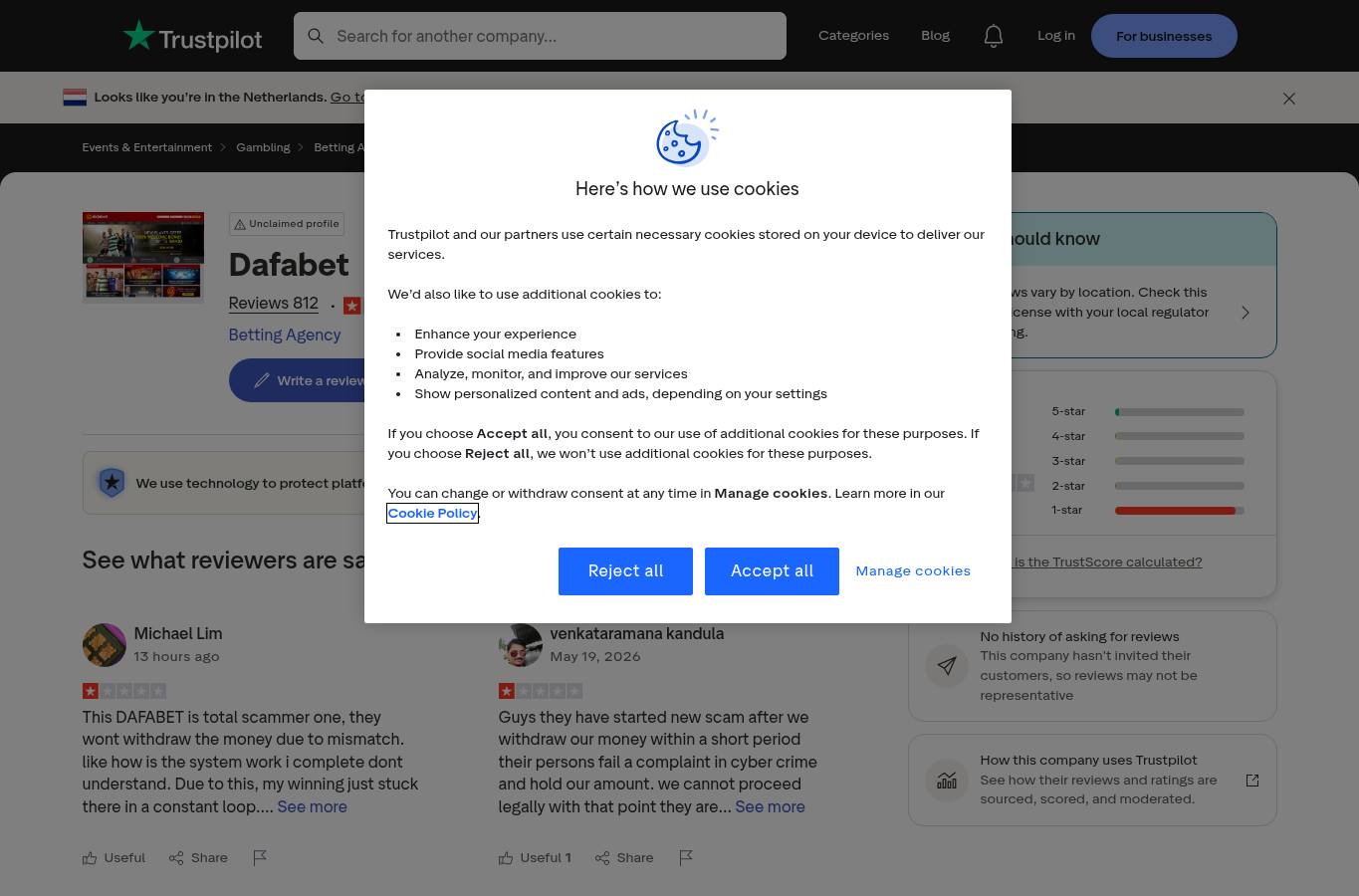
The supplied user-context material records Singapore-focused demand and access claims, but those claims are not adopted as facts here. It should not be confused with the official GRA capture, which supports the regulatory statement above. Screenshots can be dated and preserved, but they still require source-role and identity checks.
Payments: what is known and what is not
No first-hand payment test was supplied. There is consequently no verified finding about deposits, withdrawals, processing time, available currencies, fees, limits, chargebacks or the successful return of funds. Singapore-dollar demand or access claims in contextual material do not prove that a payment method is available to a particular account, that a transfer will complete, or that the recipient is authorised.
Before sending money, identify the payee shown at the final confirmation stage and compare it with the entity named in the service terms. Do not infer that a familiar bank name, wallet logo or card network guarantees the merchant. Take a dated screenshot of the amount, currency, stated fee, reference and destination, while avoiding exposure of full card numbers or identity documents.
| Payment point | Evidence status | Practical safeguard |
|---|---|---|
| Deposit method | Not tested | Do not rely on an unverified method list or promotional claim |
| Currency | Singapore-focused claims are contextual only | Confirm the final charge and conversion before authorising |
| Withdrawal | No successful test recorded | Read conditions and retain the request, status and reference |
| Fees and limits | Unknown | Record every fee; question any unexpected release payment |
| Chargeback or recovery | Not established | Contact the payment provider promptly if a transaction is disputed |
For a payment dispute, act quickly with the bank, card issuer or wallet provider using the transaction record. Do not send additional funds to an alleged recovery agent. A payment provider’s investigation is separate from a determination about gambling legality.
KYC, withdrawals and account recovery
No identity-verification or withdrawal test was conducted for this dossier. It is therefore unknown what documents a particular account would request, how long checks would take, which entity would process them, or whether a withdrawal would be completed. Never treat the absence of a complaint in the packet as proof of successful service.
Before uploading documents, inspect the exact host and the stated privacy and retention information. Redact irrelevant details where the receiving process permits it, and do not email identity documents to an unsolicited address. Keep a private log of the document type, submission date, recipient host and any case number. A legitimate-looking verification request can still be sent through a cloned page.
If an account is restricted, ask for the reason and the applicable term in writing. Save the balance display, transaction history, correspondence and identity of the stated operator. Do not create duplicate accounts to bypass a restriction, because doing so may complicate both the operator’s review and any payment-provider dispute. The packet does not establish a result for any such process.
Is it legitimate, and what does amber mean?
The signal is amber with the basis open_evidence. This means the supplied evidence does not support a current Singapore primary match for the precise host and presented entity, while it also does not provide an official adverse finding or corroborated documented conclusion that the domain is a scam. Amber is a prompt for verification and caution, not an endorsement.
The official Singapore material supports a restrictive licensing framework and identifies Singapore Pools as the only GRA-licensed remote operator in the supplied record. The operator identity is marked as presented, the licence field has no current match or expiry date, and practical payment and withdrawal performance remain untested. Those limits prevent a green signal. The packet also contains no official adverse record that would justify red.
| Signal | Meaning in this dossier | What would change it |
|---|---|---|
| Amber | Important identity or legal evidence remains open or unreconciled | A current precise primary match could support green, or qualifying adverse evidence could support red |
| Green | Not assigned here | Current primary evidence must support the precise domain and entity |
| Red | Not assigned here | An official adverse record or corroborated documented evidence would be required |
“Legitimate” is not a single test. A real domain can still be unsuitable or unlawful for a particular market, and a copied page can use a real brand name. Keep legality, identity, security and payment performance as separate questions.
Complaints, scam reports and recovery steps
Start by preserving evidence: exact host, redirect chain, date and time, messages, account identifier, transaction reference, amount, currency, payment destination and any request for further money. Take screenshots that show context, but mask passwords, one-time codes, full card numbers and unnecessary identity information before sharing them.
For Singapore-related suspected unlawful remote gambling or scam activity, use the current official reporting route indicated by the competent authority and confirm whether SPF is the appropriate destination after the recorded 1 January 2025 change. Contact your financial institution immediately about unauthorised or disputed payments. Do not describe an allegation as an established offence when making a public report; state what happened, when, through which host and what records support it.
Keep copies of case numbers and replies. If the operator offers an internal complaint route, request a written response, but do not allow that process to delay urgent contact with a bank or relevant authority. This dossier does not adjudicate any individual complaint and contains no confirmed complaint outcome.
Evidence chronology and source roles
The evidence was checked on 31 August 2026. The primary regulatory records provide the legal and licensing context. The presented operator name is a separate identity claim. The favicon is an identification asset, not a licence record. The Singapore-focused page and supplied user-signal capture are contextual material; their access, demand or service claims are not adopted as verified facts.
| Source role | Used for | Not used for |
|---|---|---|
| Primary | Singapore licensing context, legal framework and regulatory description | Proof of a private account’s payment outcome |
| Operator-presented | Recording the supplied entity description | Independent confirmation of legal identity or licence |
| User context | Showing that Singapore-related claims or signals exist in the packet | Proving access, safety, complaint truth or withdrawal success |
The method is deliberately narrow: match the exact host, separate the claimed operator from the domain, seek a current competent primary record, date each check, and label unknowns. No first-hand test was substituted for evidence, and no foreign claim was converted into Singapore authorisation. A correction should identify the precise sentence, supply a dated competent source or reproducible record, and explain whether the host or entity has changed.
What to do before proceeding
Use the amber signal as a reason to pause. Recheck the address immediately before login, do not reuse passwords, avoid unsolicited payment instructions, and retain transaction and correspondence records. If you choose to proceed despite the open evidence, do so only after understanding that this dossier does not confirm a Singapore licence, successful withdrawals, KYC performance or protection from cloned domains.
For a separate checklist, see casino verification checks and payment checks. Singapore-specific legal context is covered in Singapore gambling law. If you need to submit a factual correction, use contact and corrections.
Frequently asked questions
Is Dafabet legal in Singapore?
The supplied evidence does not establish a current Singapore GRA licence match for the precise host and presented operator. The GRA record identifies Singapore Pools as the only operator licensed to provide remote gambling services. The appropriate conclusion here is open evidence, not a definitive finding about every related domain.
Does HTTPS prove that the site is genuine?
No. HTTPS helps protect a connection, but it does not prove ownership, Singapore authorisation, safe payments or successful withdrawals. Compare the complete hostname and the account destination before entering credentials or documents.
Is Osmila N.V. confirmed as the operator?
It is recorded as “Osmila N.V. (presented)”. That wording identifies an operator claim supplied in the packet, not an independently reconciled finding from a current Singapore primary record. The legal entity, exact host and licence remain separate checks.
Were deposits or withdrawals tested?
No. There was no first-hand deposit, withdrawal or KYC test. Payment methods, fees, processing times, limits, document requests and successful return of funds are therefore unknown in this dossier.
What should I do if a clone domain requested money?
Stop communicating through the suspicious page, preserve the exact address and messages, contact your bank or payment provider promptly about the transaction, and report the matter through the relevant Singapore authority route. Do not pay an additional recovery or release fee.
How can I request a correction?
Identify the exact statement, date and host concerned, then provide a dated competent source or reproducible record supporting the correction. A correction should distinguish a domain change, operator claim, user report and official finding rather than treating them as interchangeable.