Is 20Bet Legit in Singapore? Legal and Withdrawal Check
Red marks Singapore-specific legal restrictions on unlicensed remote gambling. It is not a finding that this named brand is a scam or that a particular withdrawal failed.

20Bet does not pass the legal-status check for Singapore. Singapore’s Ministry of Home Affairs (MHA) stated on 9 June 2026 that only Singapore Pools is licensed to provide lotteries, sports betting and remote gambling services here, and that all other gambling operators are illegal. That makes the local signal for 20bet.com red. It does not, by itself, prove that 20Bet is a scam, establish fraud or show that a particular withdrawal went unpaid.
The distinction matters: the official evidence establishes a Singapore legal risk, while the supplied operator material explains a general withdrawal process. Neither source documents an individual customer outcome.
Verdict: a red Singapore legal-risk signal
The decisive record is the MHA statement about Singapore’s licensed remote-gambling market. It identifies Singapore Pools as the only licensed operator for the relevant services and describes all other gambling operators, whether online or in person, as illegal in Singapore. No supplied primary record identifies 20bet.com as an exception or shows that the exact domain holds a Singapore remote-gambling licence.
| Question | Finding | What the evidence supports |
|---|---|---|
| Is 20Bet licensed for remote gambling in Singapore? | No supporting local licence record was supplied. | MHA says Singapore Pools is the only licensed operator for remote gambling services in Singapore. |
| Why is the signal red? | Official local legal risk | The red marker follows the categorical MHA position, not a customer review or marketing claim. |
| Does red mean proven fraud? | No | The MHA record does not accuse 20Bet of fraud or document an unpaid withdrawal. |
| Was current access from Singapore verified? | No | No dated local availability or domain-access test was supplied. |
For the wider legal framework and the difference between licensed and unlicensed remote gambling, see the Singapore gambling law guide. Readers who want to compare the authorised local operator can consult the Singapore Pools evidence review.
What “scam or legit” can—and cannot—mean
“Legit” can refer to several different questions: whether an operator is legal in Singapore, whether a website corresponds to the intended brand, whether its published rules are clear, or whether a specific withdrawal was paid. These questions require different evidence. A foreign-facing withdrawal guide cannot establish a Singapore licence, and an official statement about legality does not prove the facts of an individual payment dispute.
On the available evidence, one conclusion is firm: 20Bet is not established as a licensed Singapore remote-gambling operator. A different conclusion—such as “20Bet stole a withdrawal”—would require transaction-specific records or a competent official finding that has not been supplied. Missing proof of payment is not proof of non-payment; equally, general payment instructions are not proof that any particular customer received money.
| Claim | Evidence needed | Status here |
|---|---|---|
| Legal to offer remote gambling in Singapore | Current Singapore primary licensing record tied to the operator or exact domain | Not supported; MHA identifies Singapore Pools as the only licensed operator. |
| A withdrawal process is described | Operator’s published instructions | Supported only as an operator statement. |
| A particular withdrawal succeeded | Dated transaction and receipt records | Not supplied. |
| A particular withdrawal was wrongfully withheld | Account records, correspondence and a competent finding or corroborated documentation | Not supplied. |
| The exact domain is currently reachable locally | Dated Singapore access test | Not supplied. |
The official Singapore record
MHA’s 9 June 2026 statement identifies Singapore Pools as the sole operator licensed for lotteries, sports betting and remote gambling services in Singapore. It also states categorically that all other gambling operators, in person or online, are illegal. This is the strongest available evidence because it comes from the relevant Singapore government ministry and directly addresses the local market.
The record has limits that should remain explicit. It does not name 20Bet in the quoted proposition, accuse the brand of fraud, report a complaint against it, identify a blocked 20Bet host, or decide a customer’s payout dispute. The correct use of the record is therefore narrow but important: it determines the local legal-risk signal, not the truth of every allegation someone might make about the operator.
Legal status can also differ by jurisdiction. A claim about permissions elsewhere would not establish permission in Singapore. No foreign licence, corporate ownership record or regulatory status for 20Bet was included in the accepted evidence, so none is asserted here.
What 20Bet says about withdrawals
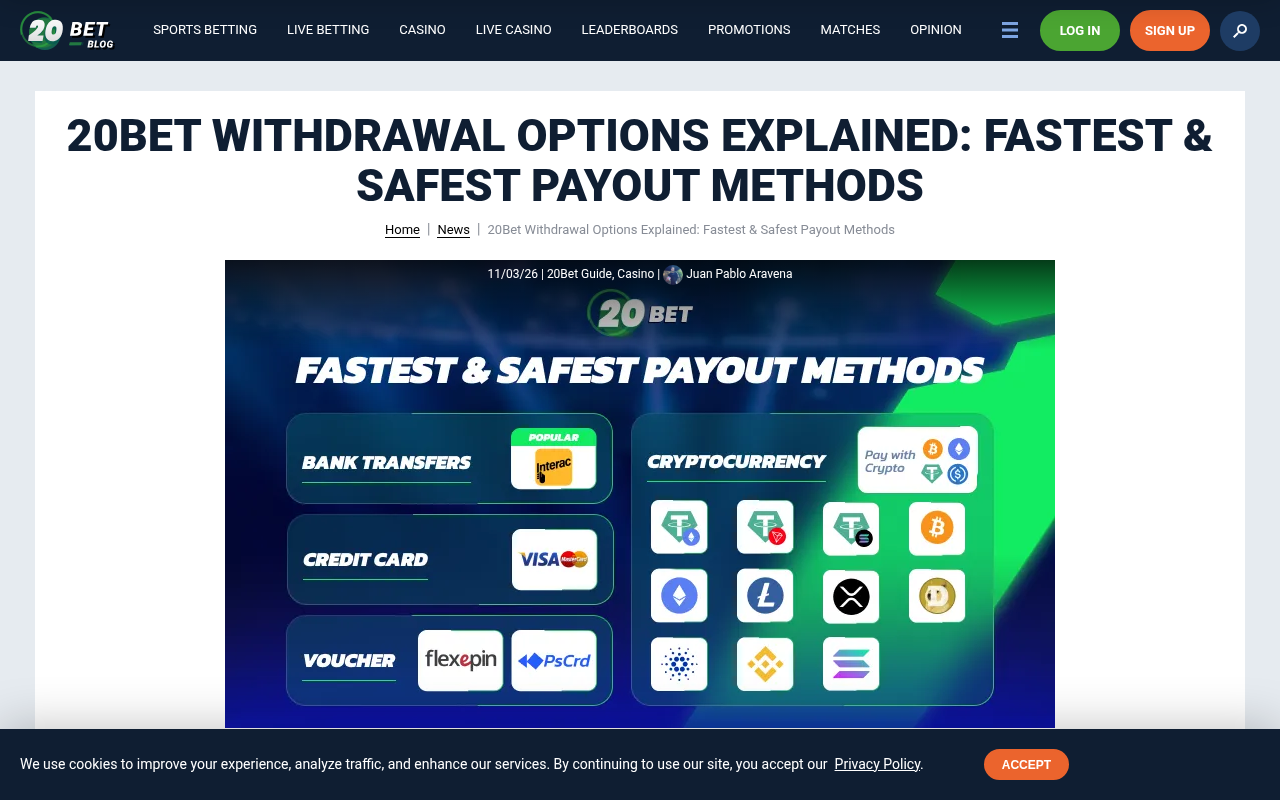
20Bet’s own withdrawal guide says that withdrawal arrangements depend on the payment method, that methods can vary by country, and that identity checks and possible delays may apply. Those statements are useful for understanding the process the operator presents to customers. They should be treated as self-reported operating information rather than independent verification.
| Operator statement | Reasonable interpretation | What it does not prove |
|---|---|---|
| Withdrawal options depend on the payment method. | The displayed route may not be identical for every account or transaction. | That a particular method is available in Singapore. |
| Methods vary by country. | A generic guide cannot be assumed to describe local options. | Current Singapore access, acceptance or legality. |
| Identity checks may be required. | A request for verification can form part of the operator’s stated process. | That every document request is proportionate, secure or correctly handled. |
| Delays may occur. | The operator does not represent every withdrawal as immediate. | That an unexplained or indefinite delay is justified. |
| A withdrawal guide exists. | The operator publishes general instructions. | A successful payout, local licence or independent audit. |
Because the guide is an operator source, it cannot independently validate its own implementation. No controlled withdrawal test, Singapore-specific payment check, bank receipt or individual account record was supplied. The safe conclusion is that a general process is described, while actual local availability and outcomes remain unverified.
How to examine a delayed withdrawal claim
If money is already involved, focus on preserving evidence rather than making another payment or relying on an unsupported accusation. A useful chronology should show what happened, when it happened and which account or transaction each message concerns. Keep original records where possible rather than cropped images that omit dates or context.
- Record the request: retain the withdrawal submission time, amount, currency, transaction reference and displayed status.
- Preserve the applicable rules: save the terms and withdrawal instructions shown at the time, including any stated verification requirement or processing condition.
- Keep correspondence: retain complete emails or chat transcripts with dates, case numbers and the exact explanations given.
- Document verification safely: note which documents were requested and when they were submitted, but redact sensitive identifiers before sharing material with third parties.
- Check the receiving account: preserve relevant bank or payment statements showing whether funds arrived or were reversed.
- Separate delay from refusal: record whether the transaction is pending, rejected, cancelled, reversed or marked as completed without receipt.
A delay alone does not establish fraud. Repeated contradictory explanations, requests for additional deposits to release funds, or a claimed completion without a matching receipt would warrant closer scrutiny, but each allegation still needs records. The payment checks guide provides a structured way to organise transaction evidence without assuming the outcome.
Warning signs that require a pause
Do not treat an operator’s general guide as permission to proceed. In Singapore, the official legal position is already adverse for operators other than Singapore Pools. If a person claiming to represent a gambling site asks for more money to unlock a withdrawal, offers a private workaround, or requests credentials that would expose a bank or payment account, pause and independently assess the demand.
- A request to make a fresh deposit, pay a “release fee” or send money to an individual before withdrawal.
- Instructions to conceal the nature of a transaction from a bank or payment provider.
- Pressure to act immediately or move the conversation to an unrecorded channel.
- Changing explanations for the same pending transaction.
- A claim that a payment was completed without a transaction reference or matching receipt.
- Requests for passwords, one-time passcodes, remote-device access or full unredacted financial credentials.
These are reasons to stop and preserve records, not automatic proof that the brand committed fraud in a particular case. For help distinguishing an allegation from documented evidence, use the complaints and scam warnings guide.
Evidence hierarchy for checking 20Bet claims
Not all records answer the same question. A primary Singapore government statement carries greater weight on local legality than promotional wording or an anonymous account. Conversely, a government statement about the market cannot show whether one customer received a transfer. Matching the source to the claim avoids both false reassurance and unsupported accusations.
| Evidence type | Useful for | Main limitation |
|---|---|---|
| Singapore primary regulatory or government record | Local licensing and legal status | May not determine an individual transaction dispute. |
| Operator withdrawal guide | What the operator says its process involves | Self-reported and not proof of performance or local legality. |
| Account and payment records | A specific withdrawal chronology | Must be complete, authentic and interpreted in context. |
| User report | A lead for further checking | An allegation unless independently corroborated. |
| Current local access test | Whether a host was reachable at a particular time | Does not establish legality, safety or payment reliability. |
The assessment methodology is explained in how casino checks are conducted. Under that approach, the official MHA position supports red for local legal risk, while the absence of a withdrawal test keeps transaction performance unverified.
If you already have money or documents at risk
Do not send additional funds merely because someone says they are required to release an existing balance. Preserve transaction records and contact your bank or payment provider promptly if you suspect an unauthorised payment, credential exposure or deception. The provider may be able to explain available security or dispute steps, but outcomes depend on the facts and its rules.
If identity documents were submitted, monitor relevant accounts and be alert to unexpected authentication requests. Avoid publishing full documents, account numbers, home addresses or security codes when seeking assistance. Redacted records can still establish dates, statuses and transaction references while reducing further exposure.
For corrections or to submit documented information for review, use contact and corrections. A report should distinguish firsthand records from assumptions and state clearly what remains unresolved. Anyone experiencing acute financial or emotional harm can use urgent help resources. Support for controlling or stopping gambling is also available through responsible gambling guidance.
Bottom line for Singapore readers
The available evidence supports a clear legal conclusion but not a fraud finding. MHA identifies Singapore Pools as Singapore’s sole licensed provider of remote gambling services and says all other gambling operators are illegal locally. With no supplied primary record establishing a Singapore licence for 20bet.com, 20Bet receives a red local legal-risk signal.
20Bet’s own guide says withdrawals can depend on the payment method and country and may involve identity checks or delays. That describes the operator’s stated process only. It does not establish Singapore legality, current local availability, a successful payout or the outcome of any individual complaint. No deposit or withdrawal test was supplied, so payment performance remains unverified.
Frequently asked questions
Is 20Bet legal in Singapore?
No available evidence establishes that 20Bet or 20bet.com is licensed for remote gambling in Singapore. MHA stated on 9 June 2026 that Singapore Pools alone is licensed for lotteries, sports betting and remote gambling services in Singapore and that all other gambling operators are illegal.
Does the red signal mean 20Bet is proven to be a scam?
No. The red signal marks official Singapore legal risk. The MHA statement does not accuse 20Bet of fraud, identify an individual blocked domain or prove that a customer’s withdrawal was withheld.
Has a 20Bet withdrawal been tested from Singapore?
No controlled Singapore withdrawal test, payment receipt or account-level transaction record was supplied. The operator’s general withdrawal guide is not proof of a successful local payout.
What does 20Bet say about withdrawal delays?
Its own guide says withdrawals depend on the payment method, methods vary by country, identity checks may apply and delays can occur. These are operator statements, not independent proof that a delay is justified or that a payment will be completed.
What records should I keep for a withdrawal dispute?
Keep the request time, amount, currency, transaction reference, status history, applicable terms, complete correspondence, verification timeline and relevant bank or payment records. Redact sensitive identifiers before sharing documents with third parties.
What should I do if I am asked to pay more to release funds?
Pause and do not send additional money solely on that demand. Preserve the request and transaction records, protect your credentials, and contact your bank or payment provider promptly if you suspect deception or unauthorised activity.