12Play Singapore: Licence, KYC and Payment Checks

Identity comes before any deposit
The first practical question is not whether a Singapore-facing page displays Singapore dollars. It is whether the service asking for money, identity documents or account credentials can be matched to a clearly identified legal operator and an applicable authorisation. The supplied evidence does not establish that match for 12Play.
The evidence packet records the operator as not established from a current primary Singapore record. It also records that no current Gambling Regulatory Authority of Singapore, or GRA, match was found. That is an evidence limitation, not a finding that a particular company has committed an offence. It means a reader should not rely on branding, a promotional offer, a domain name or a payment screen as a substitute for an operator and licence check.
A Singapore-targeted promotion page publishes SGD promotions. That supports the narrower conclusion that the page targets Singapore users. It does not establish that the service is licensed in Singapore, that the page is operated by the same entity as the principal domain, or that a payment recipient is the same entity shown in account terms.
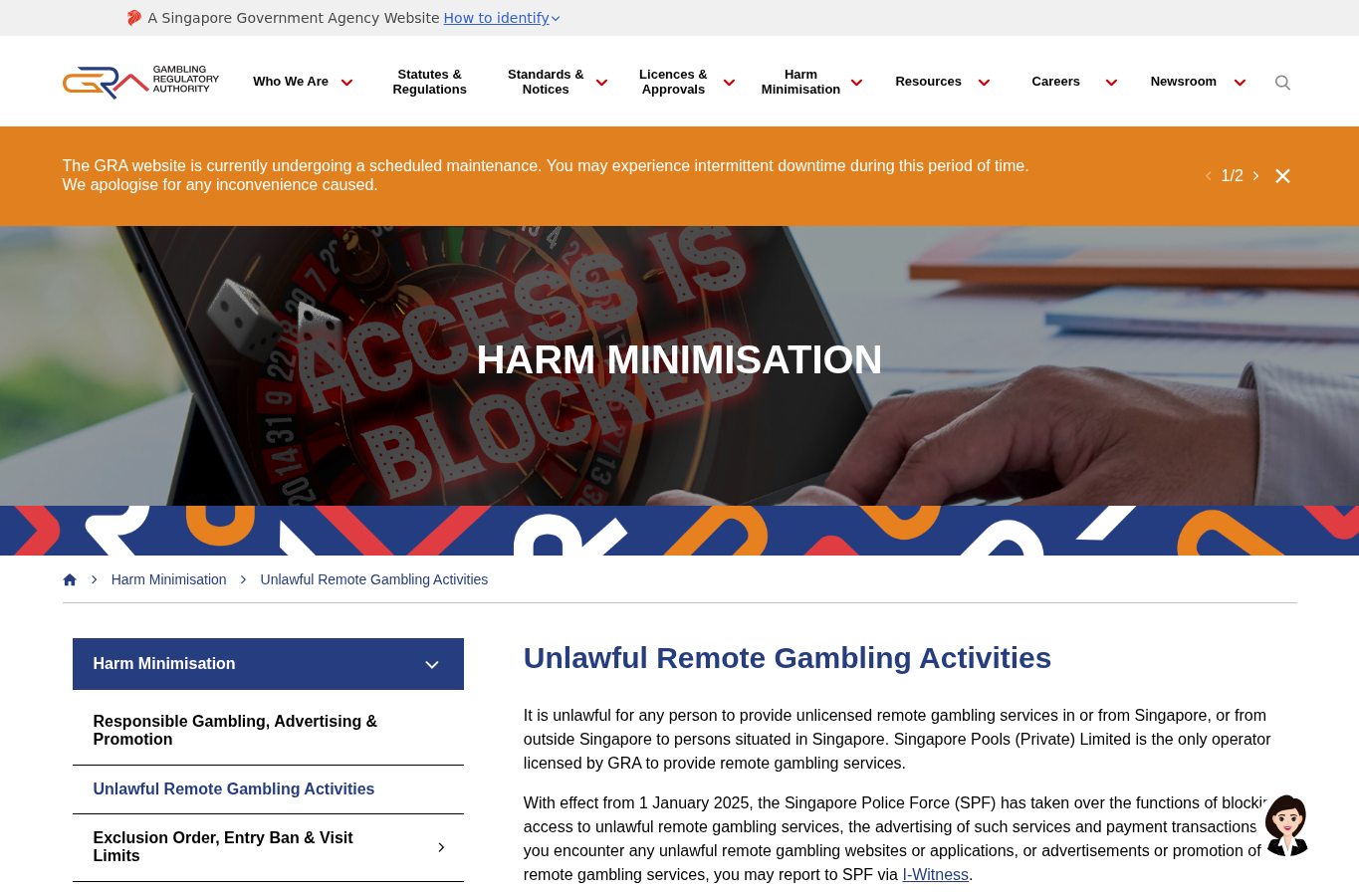
Current Singapore legal host position
Singapore’s published regulatory framework states that gambling is prohibited unless an exemption or licence applies, with GRA regulating the sector. The current GRA information on unlawful remote gambling activities identifies Singapore Pools as the only operator licensed by GRA to provide remote gambling services. The same record states that reports moved to the Singapore Police Force from 1 January 2025.
These records do not establish that every offshore or unlicensed service has the same legal status in every circumstance, nor do they decide a reader’s personal liability. They do establish why a Singapore user should demand precise evidence before treating a remote casino as lawful. A page using SGD is not an exemption, and a service being reachable from Singapore is not a licence.
For the statutory framework, consult the Gambling Control Act. For the government’s sector overview, consult the Ministry of Home Affairs gambling regulation information. Those links are legal and regulatory references, not approval of the service under review.
| Question | Supported position | What remains unknown |
|---|---|---|
| Does the page target Singapore? | An en-SG page publishes SGD promotions. | Whether targeting corresponds to lawful authorisation. |
| Is a current GRA licence matched? | No current GRA match was found in the supplied packet. | The precise legal entity and any claimed foreign authorisation. |
| Who should receive a report? | The GRA record says reporting moved to SPF from 1 January 2025. | The correct route for a particular incident depends on its facts. |
Hostname, operator and licence-chain checks
Use the exact hostname shown in the address bar, not a search result, advertisement or shortened link. The evidence packet names 12play.com as the exact domain but separately records an en-SG promotional page at 12play54.com. That difference requires checking. A related hostname may be an authorised mirror, a marketing property, a redirect, a clone or an unrelated service; the supplied evidence does not resolve which.
On an account or cashier page, record the legal name, registered address, terms version, privacy contact, complaints contact and any licence number before proceeding. Compare those details across the landing page, account terms and payment screen. A licence number without a regulator, jurisdiction, legal entity and matching domain is not enough. A corporate name in small print is also not enough if deposits are requested by a different beneficiary.
| Check | Acceptable evidence would identify | Present position |
|---|---|---|
| Browser host | The exact domain and its relationship to the Singapore-facing page. | Relationship between the named hosts is unresolved. |
| Operator | A legal entity consistently named in terms, privacy material and payment instructions. | Not established from a current primary Singapore record. |
| Licence | Regulator, licence holder, status, scope and matching domain. | No current GRA match found. |
| Mirror or clone | A verifiable operator statement or primary record connecting each hostname. | No supplied evidence resolves mirror relationships. |
Do not submit a passport, national identity card, proof of address or selfie merely to discover who will hold it. If identity collection begins before the operator and purpose are clear, stop and preserve the page, timestamp and correspondence without circulating sensitive documents.
Account ownership and KYC questions
KYC can be routine at licensed services, but its presence does not prove licensing. The important questions are who determines the purpose of collection, which entity receives the files, how long records are retained, whether data is transferred across borders and which contact handles access or deletion requests. None of those operational details is established by the supplied records.
Account ownership should be consistent. The account name, payment account, withdrawal beneficiary and identity document should normally belong to the same person, subject to the provider’s stated rules. Do not use another person’s card, bank account, e-wallet, identity document or address. Do not create duplicate accounts to bypass a restriction. Such conduct can create disputes even where the service is otherwise legitimate, and it makes the source of funds and account ownership harder to prove.
| Document or detail | Why it matters | Safe record to retain |
|---|---|---|
| Terms and privacy notice | Shows the named contracting and data-handling entities. | Version, date, hostname and relevant clauses. |
| KYC request | Shows what is requested and at what account stage. | Request text, date and non-sensitive screenshot. |
| Payment beneficiary | Tests whether funds go to the stated operator. | Transaction reference and beneficiary name, with secrets redacted. |
| Withdrawal decision | Shows whether conditions changed after deposit. | Terms cited, timestamps and correspondence. |
Payments: name matching matters
A cashier displaying SGD, familiar card symbols or a local-looking interface does not establish that funds are being received by the named operator. Before paying, compare the beneficiary, merchant descriptor, account name and currency with the contractual entity. A mismatch is a material warning sign. Do not make a small “test” deposit merely to investigate an unexplained beneficiary.
Keep records of the amount, currency, timestamp, transaction identifier, payment method and any fee. Redact full card numbers, security codes, one-time passwords, passwords and identity numbers when storing or sharing evidence. If a payment is unauthorised, contact the payment provider promptly through its official channel. Do not pay a separate release, tax, verification or recovery fee to obtain a withdrawal without independently verifying the demand.
The payment evidence supplied here does not establish available methods, processing times, fees, limits or successful withdrawals. No account test was conducted. Any promotional wording should therefore be treated as an operator statement, not as an independently tested outcome.
Withdrawals and account restrictions
There is no supplied withdrawal test and no verified result for a Singapore account. It would be unsafe to promise that withdrawals work, fail, are fast or are routinely delayed. Read the withdrawal clauses before depositing, especially rules on wagering, bonus separation, maximum withdrawals, dormant accounts, verification timing, payment-method ownership, chargebacks and document format.
Save the terms that applied when money was deposited. If a withdrawal is rejected, ask for the precise clause, the amount affected, the required documents and the identity of the legal decision-maker. Keep communication factual. Do not send repeated documents to new email addresses or messaging accounts until the recipient is verified, and never disclose an account password or one-time authentication code.
An unresolved operator identity makes a withdrawal dispute harder because the user may not know which entity contracted with them or which authority can receive a complaint. That is one reason the evidence signal remains amber.
Clone, redirect and impersonation checks
Use a fresh browser session and type the verified hostname manually. Check spelling, certificate warnings, unexpected redirects, URL parameters and whether the Singapore page changes the host. Compare the legal footer, terms, privacy notice and contact details rather than relying on visual similarity. A copied logo or familiar colour scheme proves nothing.
The supplied second capture is a user-context signal and is not proof of an official finding, payment outcome or operator identity.
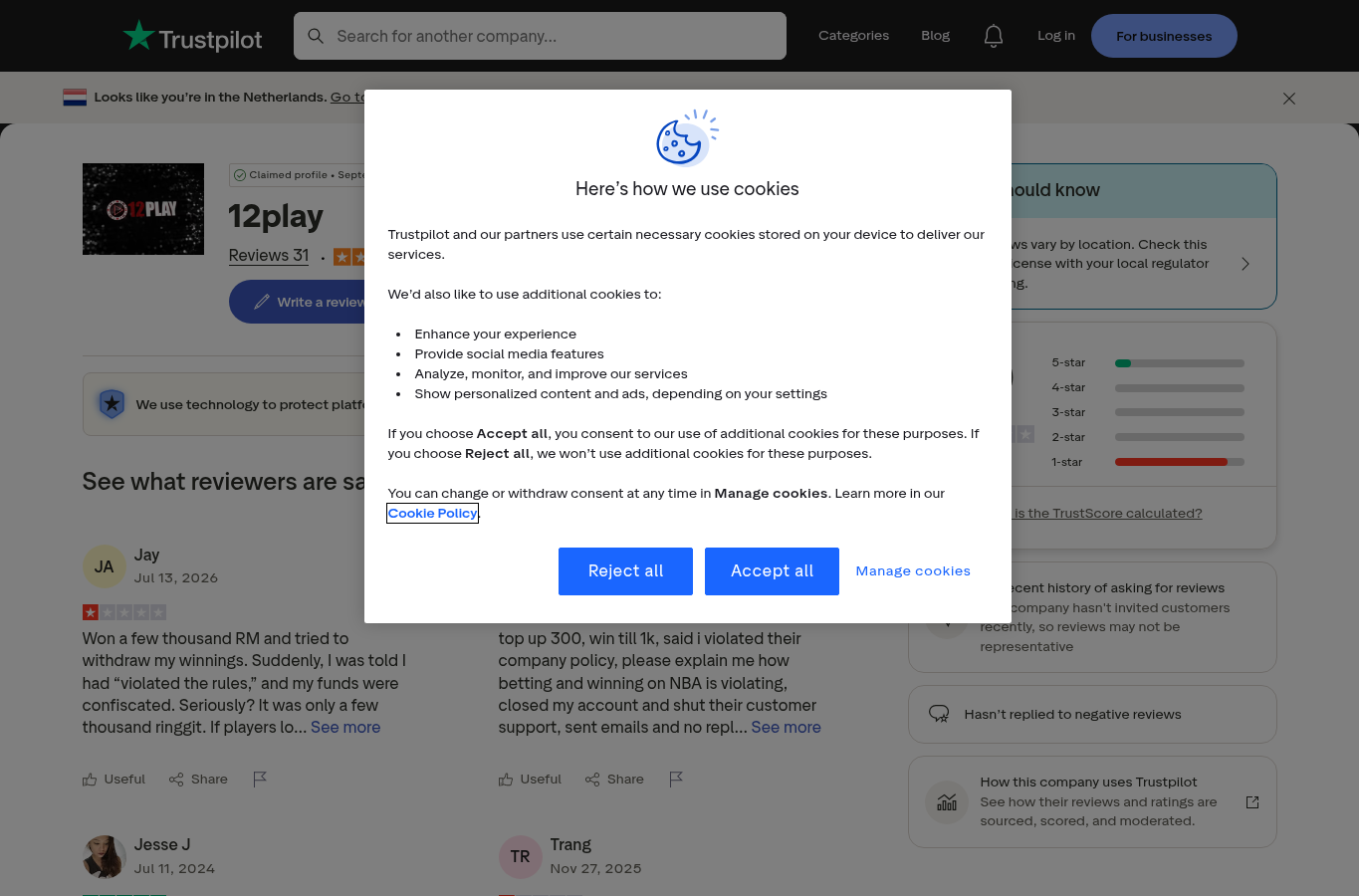
Warning signs include a request to install unknown software, pressure to move to private messaging, changing beneficiary names, urgent payment demands, promises that a fee will unlock funds, or a request for credentials outside the normal account process. These signs do not by themselves prove who operates a host, but they justify stopping and preserving evidence.
Complaint and incident packet
Start with a chronological packet. Include the exact hostname, account identifier with sensitive portions removed, dates, transaction references, the amount and currency, the promised or requested action, relevant terms, KYC requests, payment records and all correspondence. State the remedy sought in one sentence. Do not exaggerate, publish personal data or label an allegation as a proven offence.
For suspected unlawful remote gambling activity or a suspected scam, use the current official reporting route indicated by the competent Singapore authority. The supplied GRA record says reporting moved to SPF from 1 January 2025. For a payment dispute, also contact the bank, card issuer or payment provider using its verified channel. A regulator, police service or financial institution may need original records, so retain them unedited and provide copies where possible.
For practical help with documenting a dispute, use complaint and scam guidance. For a structured review of host, licence and payment evidence, use casino checks. These internal resources do not replace an official report.
Privacy, safety and decision boundary
The absence of a current primary Singapore operator match means the privacy risk cannot be evaluated fully. Unknowns include the legal data controller, storage location, retention period, processor chain and cross-border disclosure. Treat an unsolicited request for identity material as high consequence. Minimise disclosure, watermark copies where appropriate for the stated purpose, and preserve proof of what was sent.
If gambling is causing financial, emotional or relationship harm, stop making deposits and seek immediate support from an appropriate local service. Do not chase losses or borrow to continue. The responsible gambling guidance and urgent help information provide internal signposts for support and safety planning.
The decision boundary is straightforward: do not regard the service as verified for Singapore merely because it accepts SGD or serves an en-SG page. Wait for a precise, current and independently checkable match between host, legal operator, licence scope and payment beneficiary. That match is not established in the supplied evidence.
Evidence chronology and method
The evidence was checked on 31 August 2026. The primary regulatory record states that Singapore Pools is the only operator licensed by GRA to provide remote gambling services and notes the reporting change to SPF from 1 January 2025. The current statutory and government records describe the licensing, exemption, offence and minimum-age framework. Separately, an operator page publishes SGD promotions for an en-SG audience. Those sources answer different questions and must not be merged into a licence conclusion.
The method separates primary records, operator statements and user-context material. Primary records support statements about the regulatory framework. The operator page supports only the fact that it publishes Singapore-targeted promotional material. The user-context capture is not used to prove a complaint, fraud, withdrawal result or official adverse action. Missing facts remain unknown rather than being inferred.
| Evidence tier | Used for | Not used for |
|---|---|---|
| Primary | Singapore regulatory framework, licensed-operator statement and reporting information. | Proving that the reviewed service is licensed. |
| Operator | Showing that an en-SG page publishes SGD promotions. | Independent proof of legality, ownership or performance. |
| User context | Identifying a signal worth treating cautiously. | Proving a complaint, scam, withdrawal failure or official finding. |
The amber signal therefore means open evidence: the packet does not support a green verification, and it does not contain an official adverse record or corroborated documented evidence sufficient for red. Corrections should identify the precise claim, affected hostname, source, date and proposed amendment. Send that material through the corrections route.
Practical checklist before any action
- Record the exact hostname and check whether it changes between landing, login and cashier pages.
- Find the legal operator and compare it across terms, privacy material and payment instructions.
- Match any licence claim to the regulator, holder, scope, status and domain.
- Confirm the payment beneficiary before sending funds; stop at unexplained name changes.
- Read withdrawal, bonus, KYC and account-closure conditions before creating financial exposure.
- Never share passwords, one-time codes or another person’s identity material.
- Preserve dated, redacted evidence if a dispute or suspected scam occurs.
- Use official reporting and payment-provider channels rather than private recovery agents.
Frequently asked questions
Is 12Play licensed for remote gambling in Singapore?
The supplied evidence does not establish a current GRA licence match for the precise host and operator. GRA’s current information identifies Singapore Pools as the only operator licensed by GRA to provide remote gambling services. An SGD promotion page is not proof of a Singapore licence.
Does an en-SG page prove that the service is legal?
No. The en-SG page supports Singapore targeting because it publishes SGD promotions. It does not establish an exemption, licence, legal operator, domain relationship or payment-authority match.
Can I assume 12play.com and 12play54.com are the same service?
No. The supplied records name 12play.com as the exact domain and separately identify an en-SG page at 12play54.com. Their relationship remains unresolved and should be checked through precise operator and domain evidence.
Has a withdrawal or KYC process been independently tested?
No. There was no account test. Withdrawal performance, KYC handling, payment names, processing times and document retention therefore remain unknown.
What should I do if money or identity documents are at risk?
Stop further payments, preserve redacted records, contact the bank or payment provider through its verified channel, and use the appropriate official reporting route. The supplied GRA record says reporting moved to SPF from 1 January 2025.
Why is the overall signal amber?
Amber reflects open evidence. A current primary Singapore match is not established, but the supplied packet does not contain an official adverse record or corroborated documented evidence supporting a red signal.